Asemic
The Remainder
design
In the list of terms the OED offers in the place of ‘asemic’, or ‘asemia’, is the word ‘anemic’, or ‘anemia’. Perhaps it is homophony which forms the blood-lines in making-unmeaning? In meaning-unmaking? To be ‘bloodless’ is to be drained of colour, to enact a revolution without violence. Is this the function of the asemic-anemic word?
*
Genealogical research is seductive; in many cases it constitutes a direct history of seduction itself. The mother, the father, grandparents, great-grandparents, all agents and offspring of seductive intentions. The branching family tree is a story of enticement, and has itself become an enticing form of reason. One of sexual and semantic recognition and reproduction. Etymology is a form of genealogical research that likewise has an intuitive appearance of truth. A certain ‘verisimilitude’. The representation, recognition and repetition of words throughout history are a self-evident claim to their importance and functionality. For Plato, anamnesis is the idea that knowledge is recollection, it is the recovery of pre-existing knowledge which the soul already knows. This is how etymology thinks: what the soul wants is a truth which is already ‘out there’, which is already contained within the word, if only we could access it! Deleuze calls this idea the ‘image of thought’, the picture we have in our heads of what thinking is supposed to be. The thinker's job is to remove illusions, to correct errors, to draw up similarities, differences, forms of categorisation that align the mind with a world which already exists. Here, truth is both a goal and a measure of thinking as such. However, Deleuze does not like this ‘image of thought’; for him, this is not thinking at all. Thinking for Deleuze is a kind of violent encounter, a form of creation out of which truth – understood as partial and relative – can be a by-product, but which is not, in itself, a goal. Why should a soul want truth? Why should a word want a meaning? A history? For Deleuze, the thinker's job is to create concepts that generate new ways of seeing and acting. To imagine and enact new forms of seduction.
*
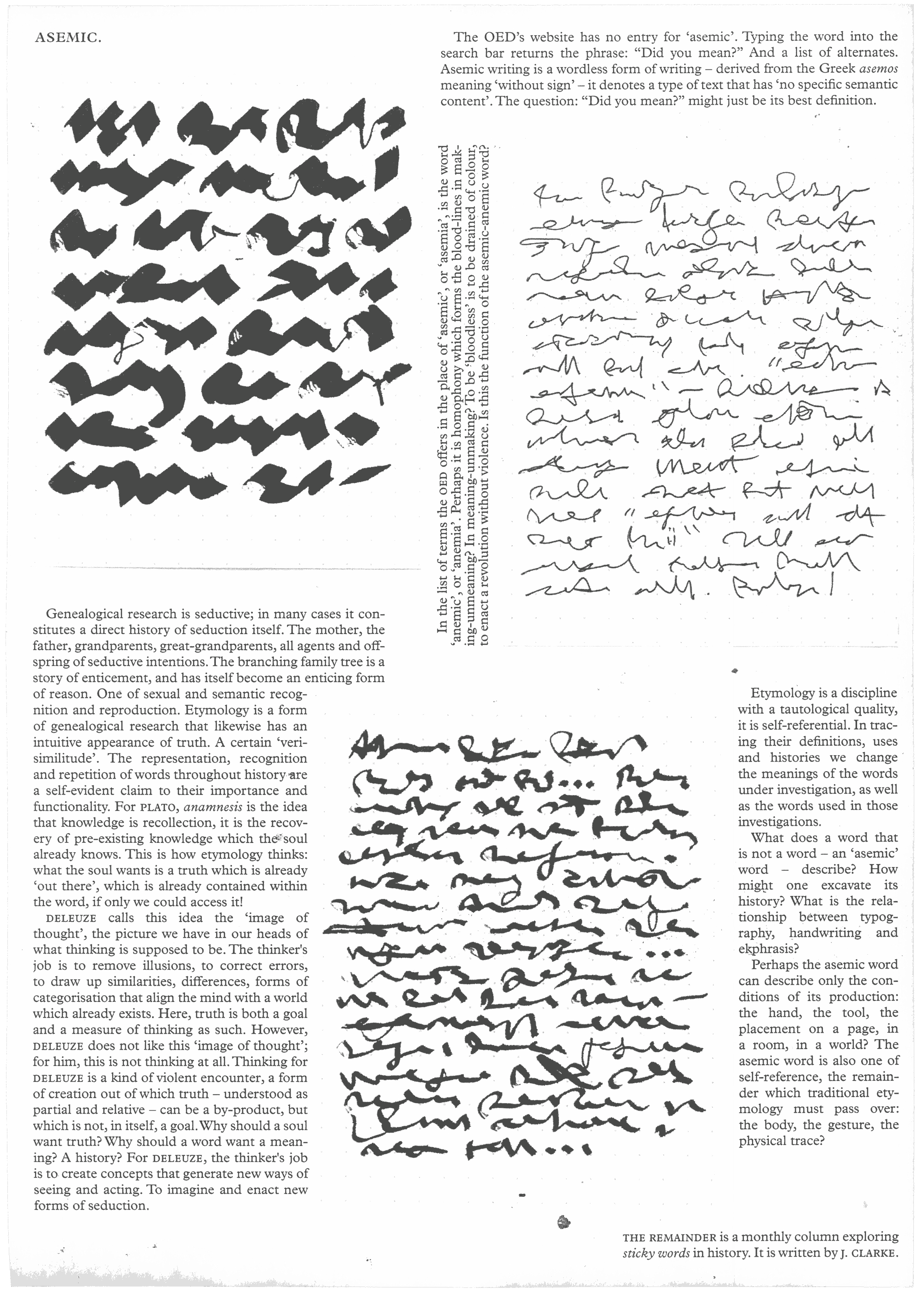
Etymology is a discipline with a tautological quality, it is self-referential. In tracing their definitions, uses and histories we change the meanings of the words under investigation, as well as the words used in those investigations. What does a word that is not a word – an ‘asemic’ word – describe? How might one excavate its history? Perhaps the asemic word can describe only the conditions of its production: the hand, the tool, the placement on a page, in a room, in a world? The asemic word is also one of self-reference, the remainder which traditional etymology must pass over: the body, the gesture, the physical trace?
This article was precipitated by listening to Holger Jacobs speak on the subject of ‘Parasitic and Symbiotic Typographic Practice’ at the 2025 Typography Theory Practice conference.
This article was written for a monthly column – The Remainder – in the Sticky Fingers monthly mailout